Free and receptor-bound
Soluble mediators act through interactions with target cells. Molecular form, concentration and receptor availability influence the response.

SCIENCE & EVIDENCE
The components of plasma, the process that keeps them together and the measurements behind the exosmart preparation.
OUR SCIENTIFIC CONCEPT
The Complete Autologous Plasma Secretome brings five biological layers into one preparation from the patient’s own blood.
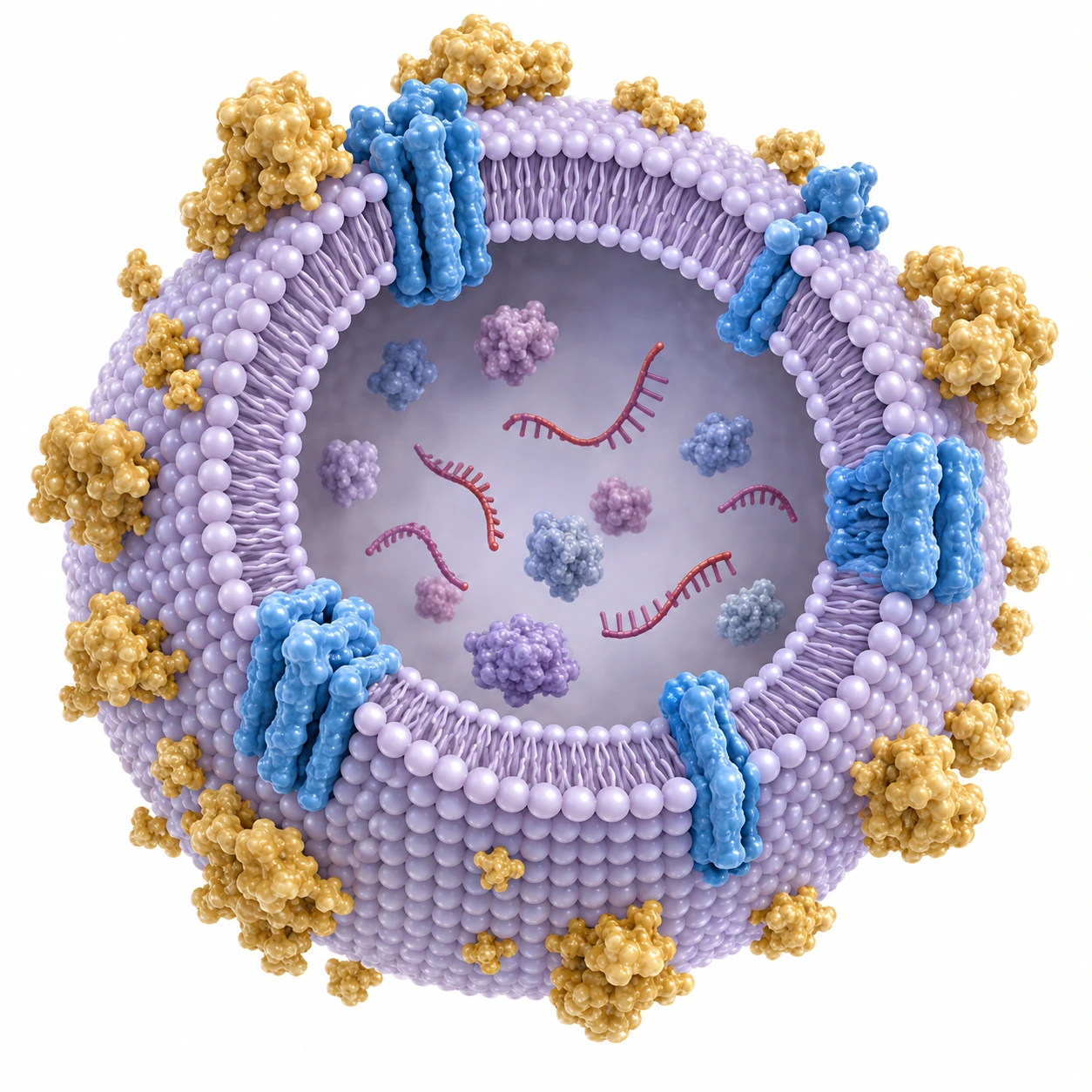
Vesicles carry proteins, lipids and RNA, while platelets store mediators involved in signalling and repair. Soluble factors act through cell receptors. Carrier and regulatory proteins influence signal transport and activity, and matrix-forming proteins contribute to tissue support.
This combination is why we process PRP and PPP together before collecting the concentrate.
The five biological roles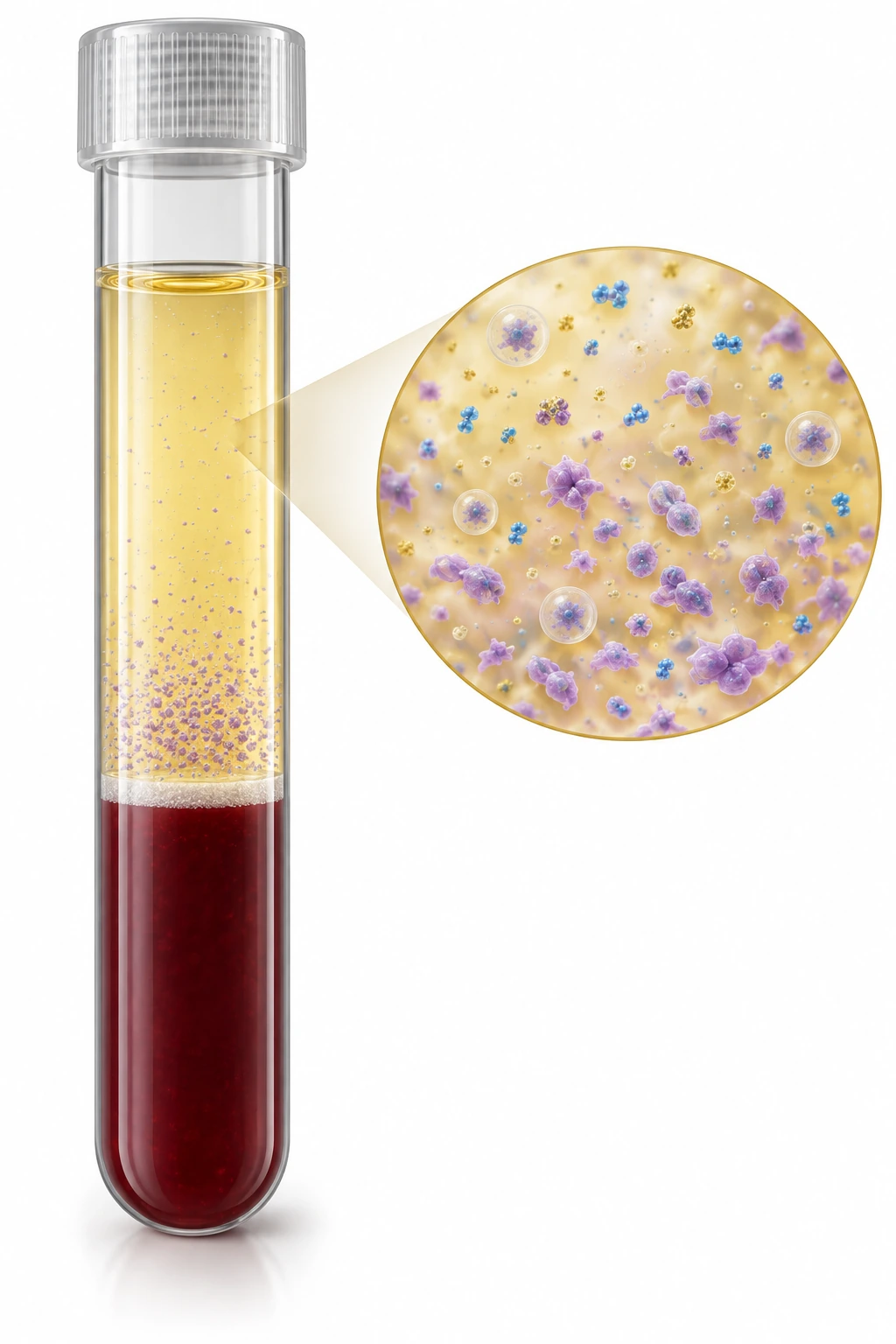
BIOLOGY IN CONTEXT
Soluble mediators act through interactions with target cells. Molecular form, concentration and receptor availability influence the response.
Binding proteins can transport and present signals. A carrier complex has different physical and biological properties from the free molecule.
The membrane, enclosed cargo and surrounding proteins all contribute to vesicle biology.
THE RESEARCH BEHIND THE CONCEPT
Research on platelet-derived material shows that vesicles and their surrounding proteins can contribute complementary biological activity.
Wolf and colleagues studied the functional protein corona around extracellular vesicles. Gomes and colleagues examined vesicles together with soluble secretome proteins in experimental regeneration models.
These studies inform our biological rationale for processing the plasma components together.
EXOSMART LABORATORY PROGRAMME
PARTICLES
Nanoparticle tracking analysis tracks light-scattering particles in a preparation. Analysis of four finished preparations measured 5–30 × 10¹² particles/mL, with median diameters of 127–178 nm.
StemExoOne · four preparations · NTA particle counts
All measurements & method detailsRepresentative original curve · sample 1
MARKERS
Western blot and flow cytometry identified CD9, CD63 and CD81 signals. These methods add molecular characterisation to particle size and morphology.
StemExoOne · Western blot and flow cytometry
All measurements & method detailsOriginal Western blot panels
GROWTH FACTORS
A third-party multiplex immunoassay measured growth factors in the final output from three donors. The values below show the observed range for each factor in pg/mL.
Woongbee Testing Center · report 2025-027-L · three donors
All measurements & method detailsEXOSMART CLINICAL OBSERVATIONS
The Academy materials include investigator-led observational series in dermatology and hair. Each summary identifies the patients, treatment schedule, follow-up and measured outcome.
Mean subepidermal low-echogenic band thickness changed from 0.143 to 0.049 mm. Nine of ten patients had at least a 50% reduction at one year. This is an ultrasound endpoint in a prospective single-arm series. This series used a 60 mL blood → approximately 20 mL plasma → approximately 8 mL output protocol.
Dermatology handbook · clinical evidenceStandardised imaging improved significantly on all six measured parameters — wrinkles, brown spots, pores, red areas, spots and texture — with the largest effects in wrinkles, brown spots and pores. Skin hydration and sebum increased significantly at all four measurement sites. Two observers blinded to time point rated 87.5% of 40 assessments as good or excellent, and none as minimal or no improvement. On FACE-Q, two patients reported minimal tightness; all other responses were “not at all”, and no inflammatory adverse effects were reported. This prospective single-arm series used a 40 mL blood → approximately 24 mL plasma → approximately 4 mL output protocol. Findings are limited by the uncontrolled design and five-week follow-up.
Dermatology handbook · study detailSeven respondents were very satisfied and two were satisfied. Follow-up included clinical photography and trichoscopy. The reported endpoint was patient satisfaction.
Hair handbook · clinical evidenceSELECTED REFERENCES
Experimental research on the contribution of proteins associated with extracellular vesicles.
Platelet-lysate research examining complementary activity in experimental models.
Compositional study of A2M-rich plasma prepared using a separate hollow-fibre system; supports the broader plasma-protein rationale.
International recommendations for describing EV preparations, methods and results.