Signals
Platelet-associated mediators and vesicles contribute to cell communication.

APPLICATIONS / ORTHOPAEDICS & SPORTS MEDICINE
For clinicians treating joint and tendon conditions, with a focus on repair biology, pain, movement and rehabilitation.
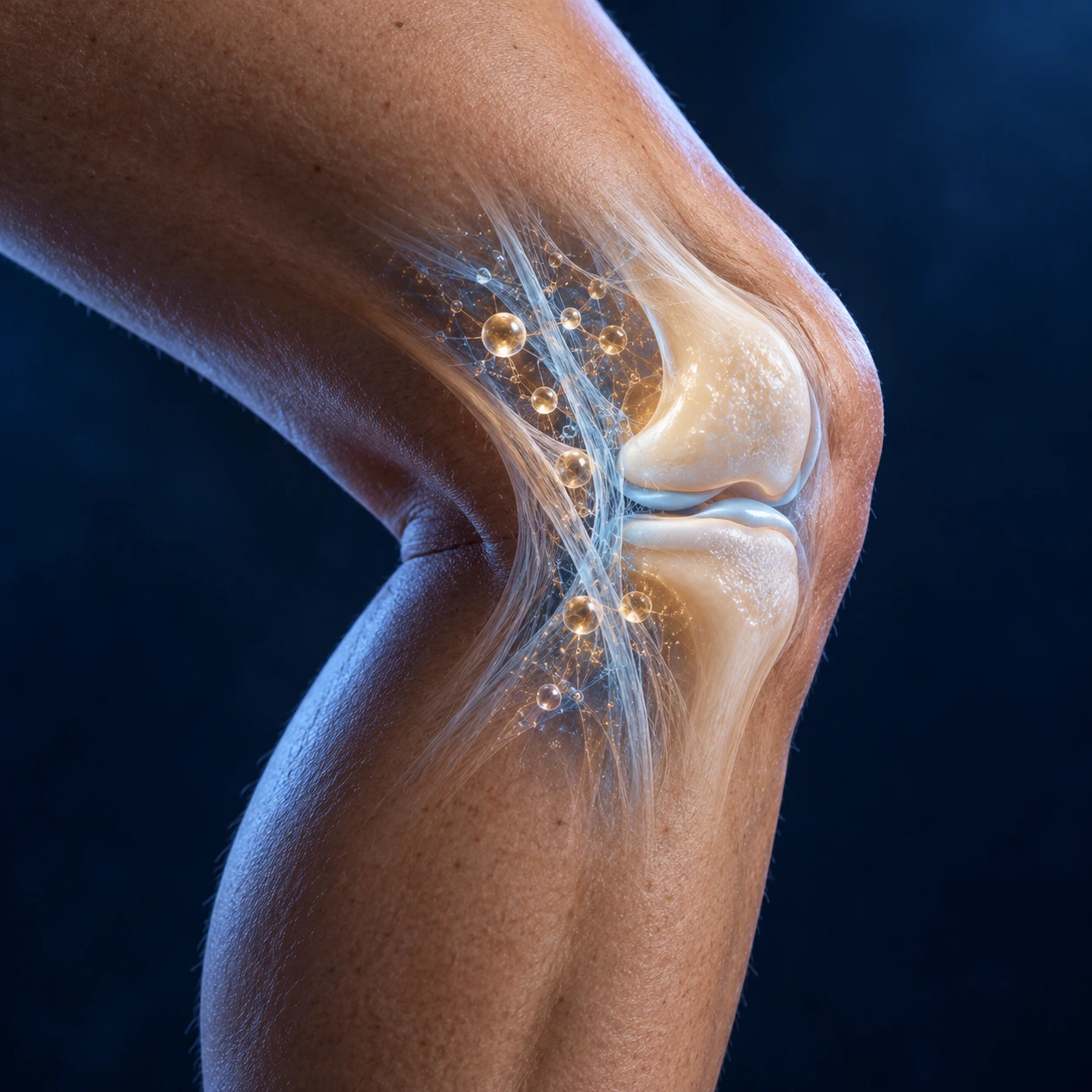
THE TISSUE & THE PREPARATION
A joint is a living environment: cartilage, synovium, fluid and supporting tissues interact. In tendons, cells and extracellular matrix respond to both biological signals and mechanical load.
exosmart concentrates PRP and PPP together, combining platelet-associated signals with the surrounding plasma proteins. The orthopaedic handbook covers patient assessment, preparation, treatment planning and rehabilitation.
Platelet-associated mediators and vesicles contribute to cell communication.
Plasma proteins such as α2-macroglobulin participate in protease regulation.
Fibrin-forming proteins contribute to the repair environment. Rehabilitation provides the loading that guides tissue adaptation.
CLINICAL FOCUS
Knee osteoarthritis is a principal teaching focus. Assessment follows pain, mobility and daily function in the affected joint.
The target, symptom duration and loading programme shape preparation, delivery and follow-up.
At a tendon-to-bone or graft interface, mechanical repair and biological integration are considered together in procedure-specific education.
CLINICAL LITERATURE & PLASMA BIOLOGY
Our handbook brings together the PRP clinical literature, plasma-protein research and the exosmart preparation. Studies are organised by tissue, comparator and outcome so clinicians can follow the reasoning for a particular joint or tendon.
ASSESSMENT & FOLLOW-UP
The intervals below are educational follow-up guidance, not the schedule of a specific study. Record a baseline and adapt follow-up to the condition, procedure and patient. Refer to the specialty handbook for treatment planning.
Record the diagnosis, target, pain and functional baseline.
Review symptoms, irritability and loading progression.
Assess pain and function against the original clinical objective.
Use the measured response and rehabilitation progress to plan the next step.
What to record Pain · function · activity · loading tolerance
PROFESSIONAL EDUCATION
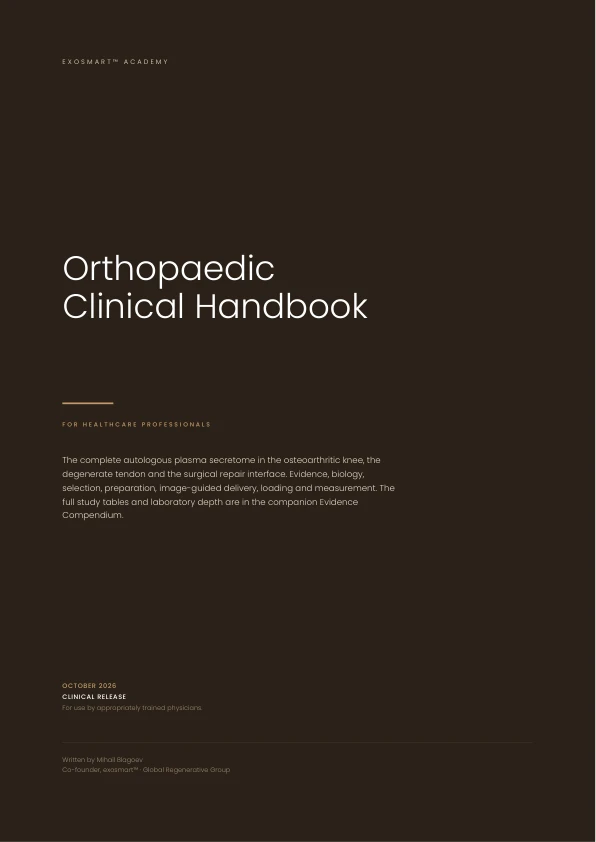
EXOSMART ACADEMY · OCTOBER 2026
Biology, clinical evidence, assessment and follow-up for orthopaedics.
Written by Mihail Blagoev, co-founder of exosmart and Global Regenerative Group. Use the companion Evidence Compendium for study detail and the Pocket Card for a concise clinical reference.
Read the handbook All orthopaedics resourcesYOUR PRACTICE
Contact us for device preparation training, scientific documentation and education for your specialty.